Make the inventory answer a real question
The most useful yarn stash inventory answers: ‘Do I already have something suitable, and can I find it?’ A beautiful colour-coded list is less helpful if every location says ‘somewhere upstairs’.
Choose one drawer, basket or box. Give it a short location name such as B01. Sort its yarn into identifiable batches and photograph each label beside the yarn. You can add the next box another day. Starting small also shows which fields you actually use before you commit to a complicated system.
Record these details for each yarn batch
Use a separate row when the colour or dye lot differs. Give the row a stable ID, such as Y014, and put that same ID on a removable tag or storage bag. Names like ‘blue cotton’ are rarely distinctive enough once the stash grows.
Record the yarn’s thickness category separately from its mass in grams. The Craft Yarn Council’s standard yarn-weight categories describe thickness; they do not tell you how many grams remain in your ball.
| Field | What to write |
|---|---|
| Yarn ID and location | Y014 · box B01 · front pouch |
| Identity | Brand, yarn name, fibre, colour name and code |
| Batch | Dye lot exactly as shown; ‘unknown’ if missing |
| Label quantities | Metres per ball and grams per ball |
| Current quantity | Full balls plus weighed partial balls |
| Reservation | Project ID and quantity set aside |
| Evidence | Label photo and date last checked |
Check the Craft Yarn Council’s standard yarn weight system ↗
Estimate how much is left in a partial ball
If the original label gives both length and mass, you can estimate remaining length from the remaining yarn’s mass. Remove packaging and do not include a cardboard cone or other core. This is an estimate: manufacturing variation, moisture and scale accuracy can affect it.
Use remaining metres = remaining grams × labelled metres ÷ labelled grams. Keep the original units consistent; do not mix yards with metres in the same calculation.
| Step | Value |
|---|---|
| Original label | 240 metres per 100 grams |
| Remaining yarn mass | 35 grams |
| Calculation | 35 × 240 ÷ 100 |
| Estimated length | 84 metres |
An 80-metre project would leave only about 4 estimated metres in this example. Treat that as a close call, not a guarantee. Allow for the pattern, your gauge and any swatching or finishing yarn needed.
Separate what you own from what is available
If the same yarn appears in two future projects, it can look as though both are covered when only one is. Keep three separate numbers: physically on hand, reserved for planned work and available to allocate.
For example, 180 grams on hand minus 60 grams reserved leaves 120 grams available. When you use 20 grams on that reserved project, the physical total becomes 160 grams and the remaining reservation becomes 40 grams. Available yarn stays at 120 grams. Reducing both figures stops you subtracting the same use twice.
- On hand: yarn you can physically count or weigh now.
- Reserved: part of that yarn allocated to unfinished or planned work.
- Available: on hand minus current reservations.
Do not combine this method with a second stock deduction for ‘used yarn’. Choose one consistent system and keep a note explaining it.
Keep unknown yarn useful without guessing its details
A missing label does not have to stop the whole inventory. Record the actual mass, location and a photograph, then mark the fibre, colour code or dye lot as unknown. Do not turn a visual guess into a confirmed fact.
Keep unidentified leftovers in their own group until you can choose an appropriate use. Record what you learn from a swatch alongside the yarn ID. When a project depends on a particular fibre, care method or exact colour match, use confirmed information rather than assuming similar-looking yarn will behave the same way.
Update the stash when something changes
An inventory becomes stale when updating it means reorganising the entire room. Attach the update to an event you already notice: buying yarn, reserving it, finishing a project or giving it away. A short update at those moments is easier than a full recount each week.
When you put a project down, keep its yarn ID with the hook size and stopping point. When you finish, weigh the remainder and return it to its recorded location. If the yarn moves to a different box, change the location before you forget.
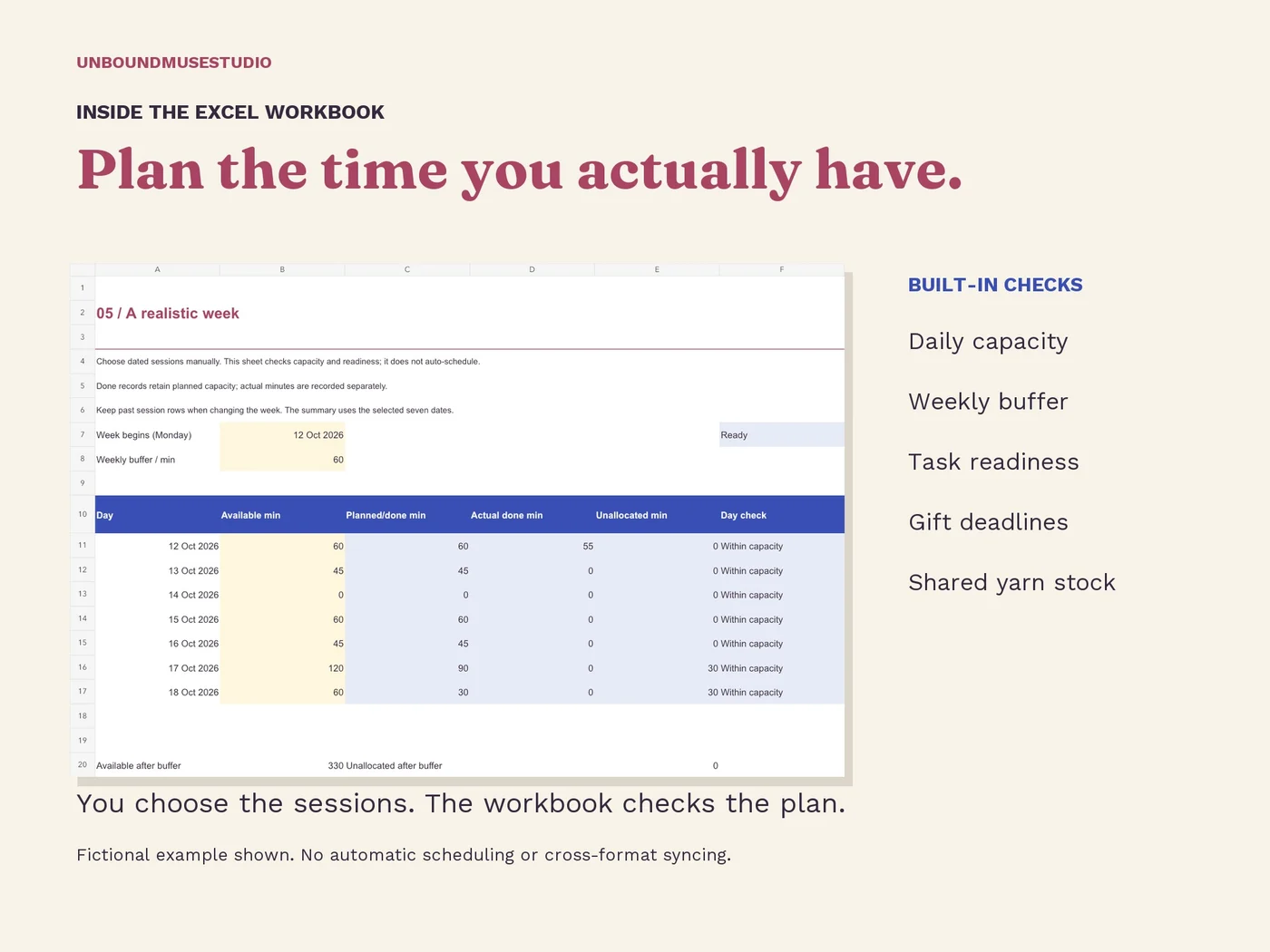
Stitch & Finish Studio includes spreadsheet, fillable PDF and Notion versions. Pick one main record: they are separate formats and do not automatically synchronise.
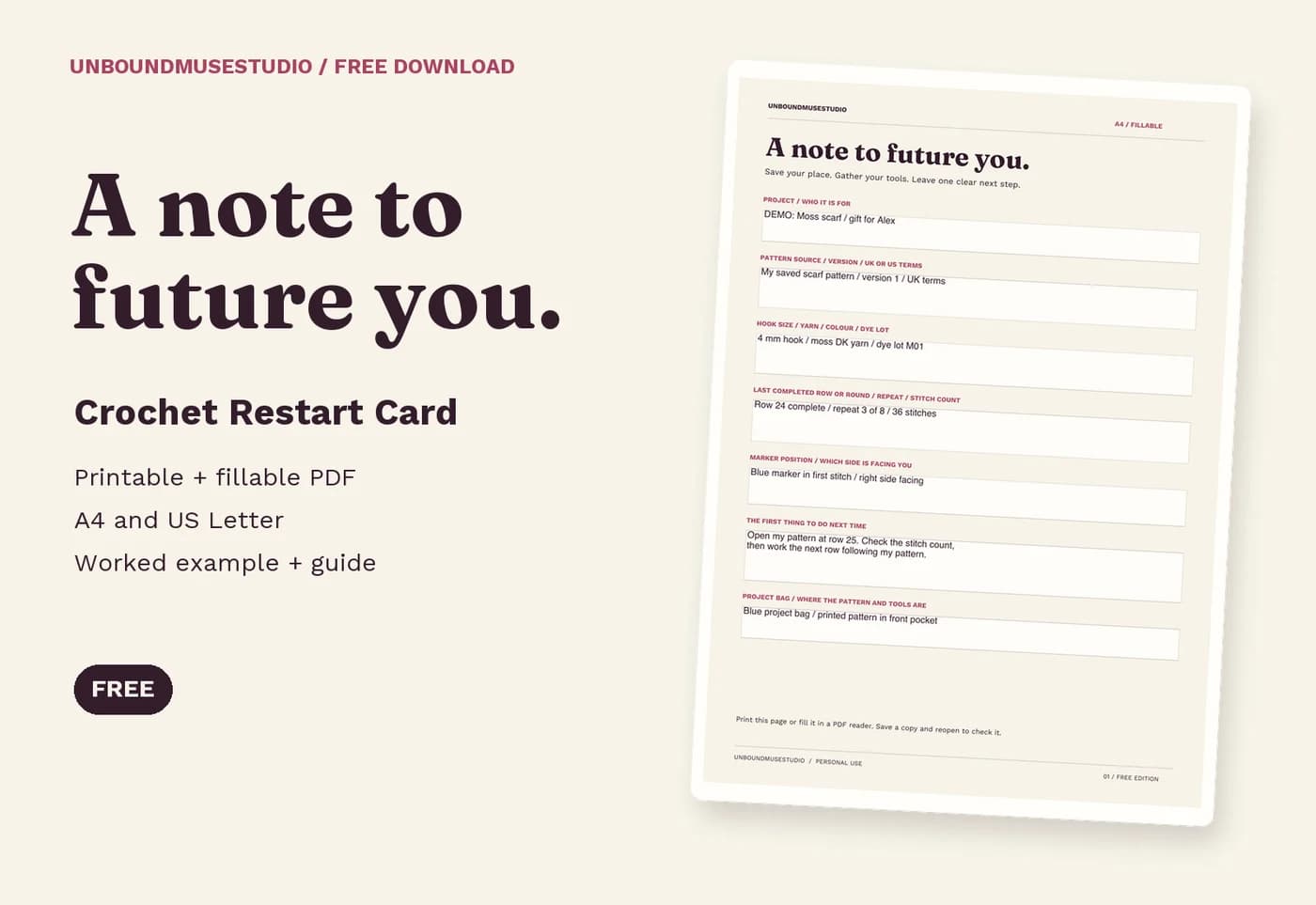
Leave a crochet restart note that connects to your yarn record →