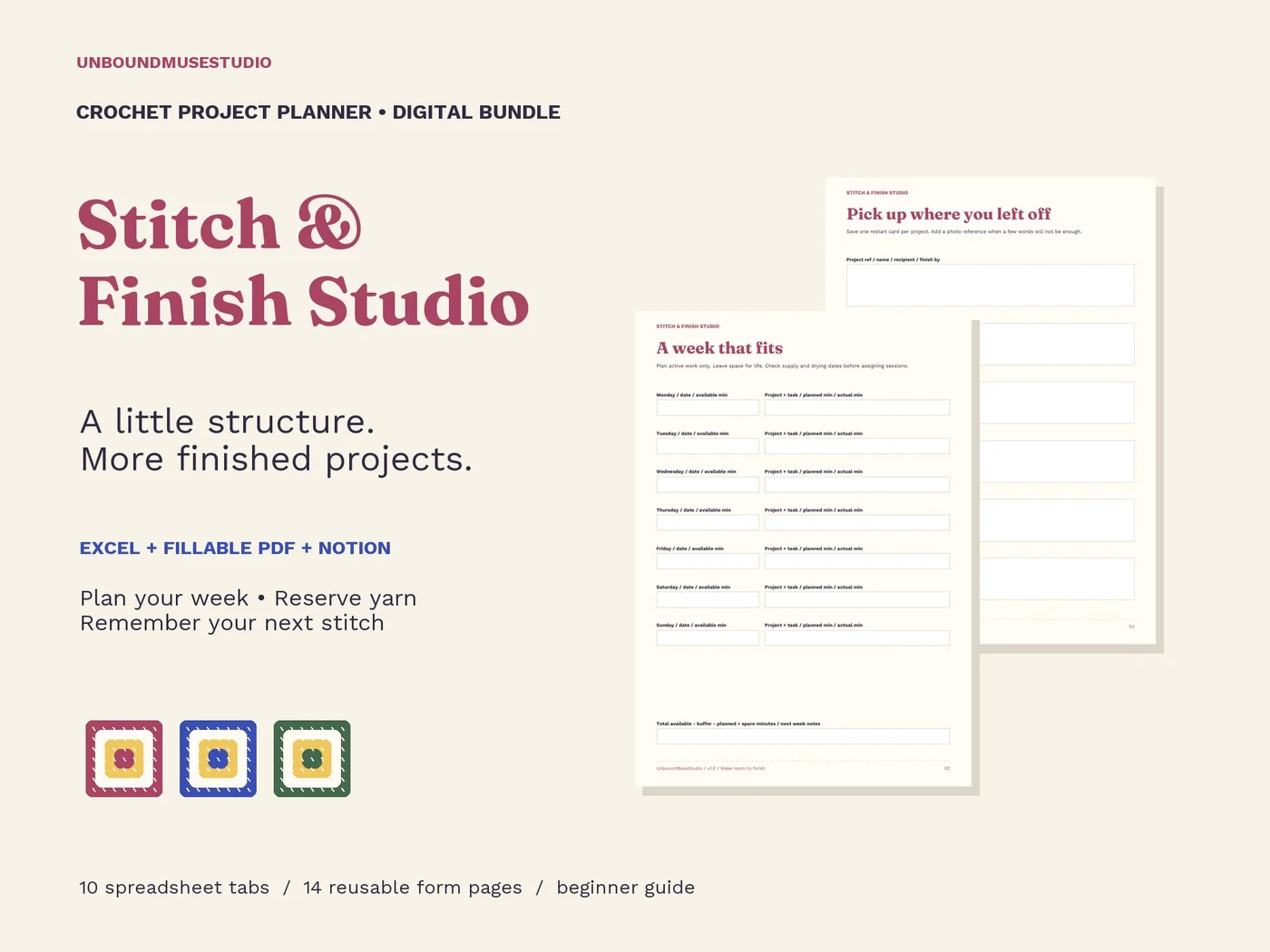
Stitch & Finish Studio
£12.99Crochet project planner & yarn stash tracker
Spreadsheet · Fillable PDF · Notion
HANDMADE. THOUGHTFULLY PRICED.
Your yarn has a cost. Your time does too.
Turn both into a price you can explain.
YOUR MAKER’S WORKSHEET
Example loaded. Change the figures to your own costs.
Price for your chosen margin
£32.00Rounded up · per sellable item
Covers the costs you entered, including labour, with no extra profit.
This is a costing result, not a promise that buyers will pay it. Review your audience, product and actual selling costs.
BEFORE YOU RUN A SALE
At £30.00: £4.70 profit after entered costs and labour.
After 10% off (£27.00): £1.76 profit.
No signup. No automatic saving. Download or print before leaving. Your entries stay in this browser tab.
HOW TO PRICE CROCHET ITEMS
This crochet cost calculator works for amigurumi, hats, bags, blankets or a set sold as one item. Use your own measured materials and time.
First add yarn, other materials, packaging, allocated overhead and labour. Labour = batch minutes ÷ 60 ÷ batch items × hourly rate.
Enter rates as decimals in the formula: 2% is 0.02. Fees and margin must total less than 100%. The tool then rounds up to your chosen price increment.
For the fictional coaster set, yarn costs £3.60, other materials £0.60, packaging £1, overhead £1.20 and 90 minutes at £12/hour adds £18 labour. That is £24.40 in costs. With a £0.30 fixed fee, 2% selling fee and 20% profit margin, the target is £31.67, rounded up to £32. Profit after the entered labour and costs is £6.66.
These example costs and rates illustrate the calculation; they are not a market price recommendation.
Divide the price you paid by the pack amount, then multiply by the amount used for one item. A £6 ball weighing 100g with 60g used costs £3.60. Weigh before and after, or use consistent metres or yards. Add a separate row for each yarn. Include wasted yarn in the amount used if you want to recover it.
No. A markup adds a percentage of cost. A margin is the percentage of the selling price left after costs. With £20 cost and no fees, a 20% markup gives £24, while a 20% margin gives £25. This tool uses margin and includes your entered selling fees.
Yes, as a costing worksheet. Enter the fees that actually apply to your shop or payment provider; there are no automatic marketplace rates. Spread fixed order fees across items where appropriate. For markets, allocate a share of event costs to overhead without counting them twice. Check your actual fees, tax treatment, shipping and discounts separately.
No automatic tax, VAT or shipping calculation is included. The result uses only the costs you enter and treats percentage fees as a percentage of the item price. If fees also apply to postage or tax, calculate and allocate those costs separately. It is a practical estimate, not a full accounting system.
Different makers have different materials, speeds and costs. Review your recorded time, product size, finishing and audience. Try simplifying a design or batching work and recalculate honestly. A lower selling price may mean less pay for your time; the price-test panel makes that trade-off visible.
Use the original or replacement cost if you want the next sale to help replenish supplies. Entering zero is allowed, but it means the price does not recover a yarn cost. Keep a note of which approach you used so you can compare items consistently.
Download a CSV or print and choose Save as PDF. Entries are not saved automatically or sent to our servers. Refreshing clears your work. Currency selection changes the symbol only, so keep every input in the same currency.
KEEP YOUR CROCHET PLANS TOGETHER
Crochet project planner & yarn stash tracker
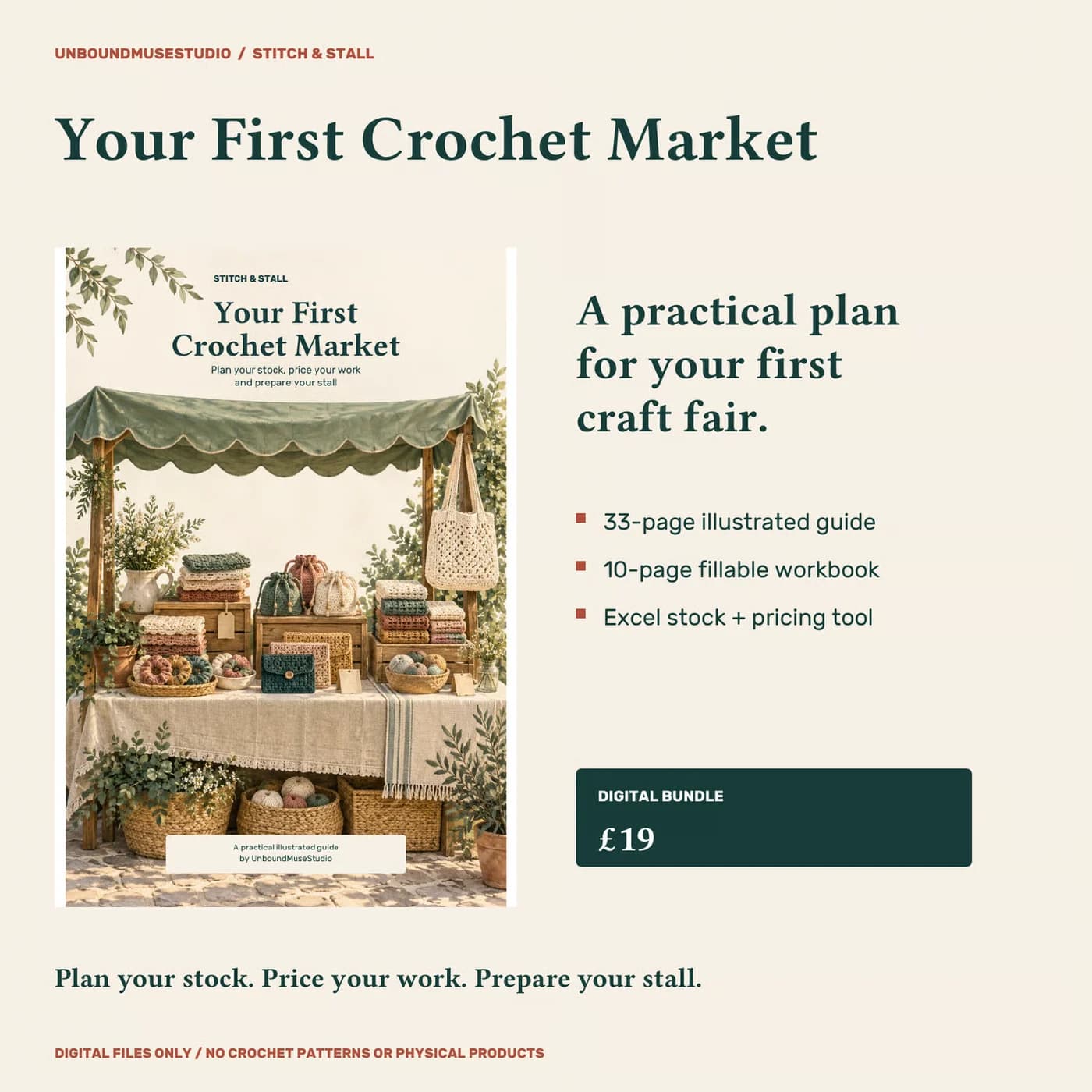
Illustrated craft fair guide, workbook & calculator
 On the house